Creative Ways to Battle Staffing Shortages

Two Ways Can Be Alleviated - Academic Community and Open-House Recruiting

september 2021

By Jody Randall MSN, RN, CIC, HACP-CMS, HACP-PE

CEO and Founder

Pure exhaustion of healthcare workers is one of the major reasons that so many healthcare professionals are leaving the industry. The time has come to bring in the reinforcements! Two ways this can be alleviated are by involving the academic community and open house recruiting.   Many institutions of higher learning are desperately seeking clinical experiences for students who are interested in entering the healthcare field. Clinical experiences help students to gain the essential practical and critical thinking skills necessary to become competent in the profession. This is an ideal opportunity for all healthcare administrators to consider hosting clinical experiences for students. Despite the possibility of initial resistance and apprehension of your clinical team members who may be reluctant to precept students in the clinical environment; rest assured, the benefits will most certainly outweigh concerns. It is time to mold a new generation of healthcare professionals to support the tired and weary through these difficult times.   Open house recruiting is another opportunity to recruit a variety of talented and skilled healthcare workers. This is one method that many larger healthcare facilities have moved to but the size of the facility does not necessarily matter. The issue that most healthcare facilities are dealing with today is that despite applicants applying for positions, Human Resources personnel are not able to effectively manage the constant staff turnover as well as the onboarding of new staff members from day to day. Having a scheduled open house event to recruit new team members can be a much more efficient way to capture the interested of the many talented healthcare workers seeking a new opportunity in what has become a very competitive healthcare market. Additionally, this will enable organizations the opportunity to fill vacancies in a much more efficient and timely manner.

Woman sitting at a desk, holding her shoulder while working on a laptop in a bright room.
June 4, 2026
OSHA's General Duty Clause and Ergonomic Risks Under Section 5(a)(1) of the Occupational Safety and Health Act (the General Duty Clause), healthcare employers are legally required to provide a work environment free from recognized hazards that cause or are likely to cause death or serious physical harm. Manual patient lifting, transferring, and repositioning represent significant ergonomic hazards. OSHA actively inspects healthcare systems for musculoskeletal disorders (MSDs) and mandates that hospitals implement engineered control solutions, such as ceiling lifts, sit-to-stand devices, and friction-reducing slide sheets.
May 5, 2026
The Technical Baseline: NFPA 99 Health Care Facilities Code NFPA 99 (2012 Edition, as mandated by CMS) establishes risk-based categories for electrical and gas systems based on the risk to patients. Category 1 spaces are those where procedures are performed that could result in major injury or death if utility systems fail. Under Chapter 6 (Electrical Systems), facilities must maintain isolated power systems (IPS) and line isolation monitors (LIM) in wet procedure locations to protect patients against electrical shock.  Survey Vulnerabilities: CIHQ and Joint Commission Directives During surveys, both TJC and CIHQ closely inspect the testing logs for these specialized electrical environments. TJC Standard EC.02.05.01 requires facilities to manage utility risks, specifically focusing on the routine inspection of ground- fault circuit interrupters (GFCIs) and the regular calibration of LIM alarms. CIHQ surveyors frequently evaluate surgical staff on their understanding of the LIM panel: if an alarm sounds, do clinicians know that it signifies a critical loss of electrical isolation that could cause patient harm if a second fault occurs? OSHA 29 CFR § 1910 Subpart S Alignment While NFPA 99 protects the patient, OSHA Subpart S (Electrical Safety) safeguards the clinical staff operating the machinery. Employers must ensure all electrical medical devices are free from recognized hazards. Exposed wiring, unapproved extension cords, or failing to lock out/tag out malfunctioning medical hardware violates OSHA standards and places both employees and patients at immediate risk.
Red fire alarm box on a white hallway wall with a long corridor in the background
April 4, 2026
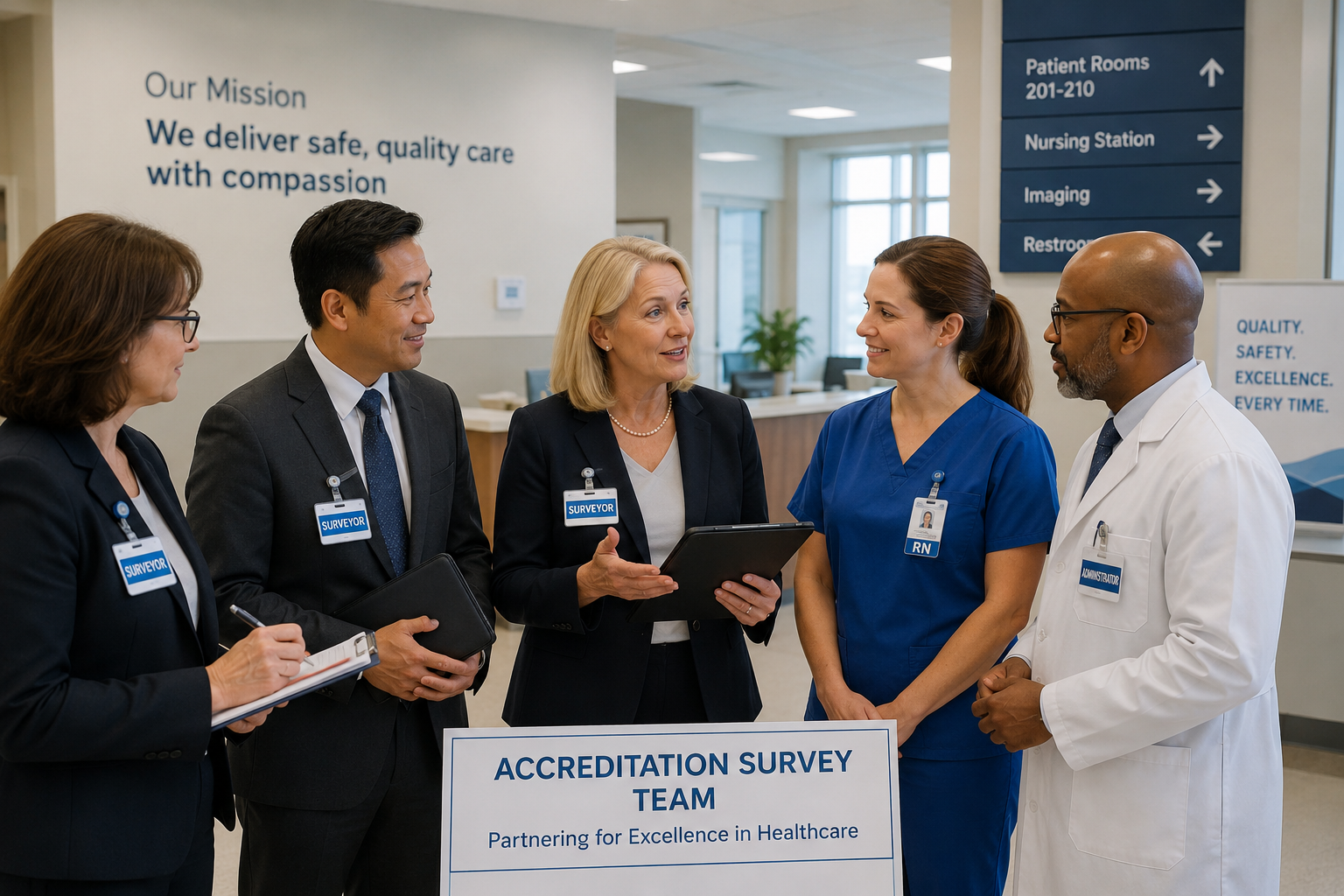
CMS Conditions of Participation (CoPs) and the Unified Focus The Centers for Medicare & Medicaid Services (CMS) establishes the baseline for safety through the Conditions of Participation (CoPs). Under 42 CFR § 482.41 (Physical Environment), hospitals must ensure that the physical plant is constructed, arranged, and maintained to secure the safety of patients. CMS holds leadership strictly accountable for ensuring that life safety deficiencies do not interfere with clinical intervention. When a surveyor enters a facility, they cross- reference the clinical patient logs with facility maintenance schedules to ensure environment-driven risks—such as positive/negative pressure room failures—did not impact immunosuppressed patients. Accrediting Bodies: CIHQ, Joint Commission and Other Aos’ Interventions Accrediting organizations like The Joint Commission (TJC) and the Center for Improvement in Healthcare Quality (CIHQ) act as the enforcement arms for CMS via deemed status. TJC’s Environment of Care (EC) and Life Safety (LS) chapters explicitly detail how physical space directly impacts clinical delivery. For instance, TJC Standard EC.02.03.05 requires hospitals to maintain and test fire protection and suppression systems, mapping directly back to Life Safety Code compliance. Simultaneously, CIHQ’s structural surveys place massive emphasis on a unified environment. CIHQ approaches physical plant standards as a direct extension of standard clinical operations. They emphasize that blocked egress corridors or improperly stored medical equipment don't just constitute technical facility violations; they are direct barriers to rapid code-blue response and emergency patient evacuations.